Masa Funabashi a présenté les projets de Synécoculture lors de plusieurs conférences à Paris.
・Conférence : « Synécoculture : l’agroécologie augmentée par les sciences de la complexité »
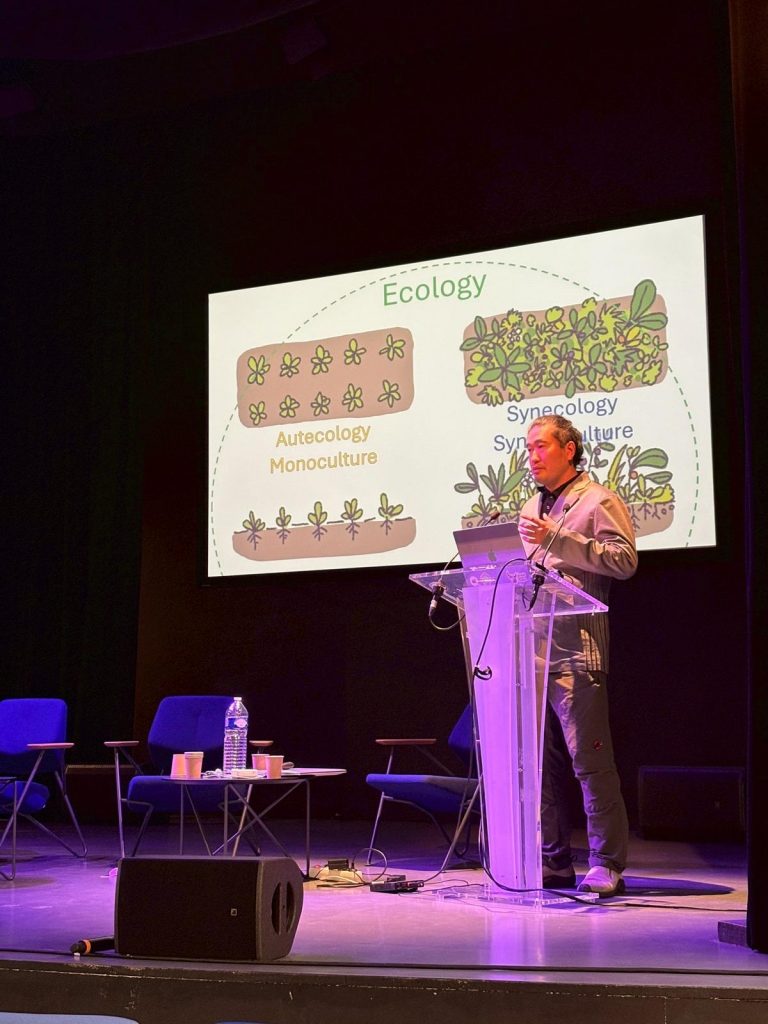

Conférence sur la Synécoculture avec Vergers Urbains:



Masa Funabashi a présenté les projets de Synécoculture lors de plusieurs conférences à Paris.
・Conférence : « Synécoculture : l’agroécologie augmentée par les sciences de la complexité »
Conférence sur la Synécoculture avec Vergers Urbains:

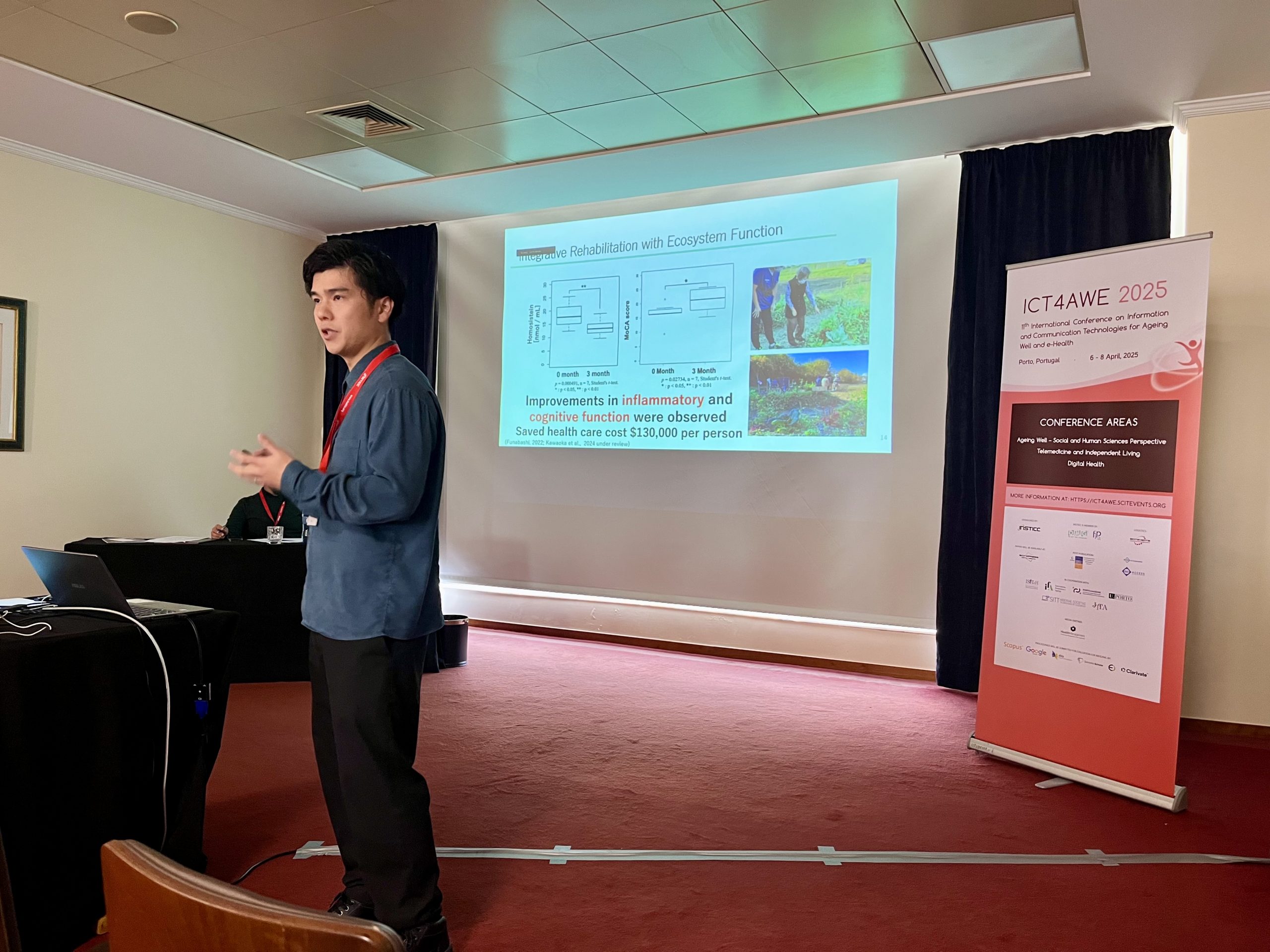
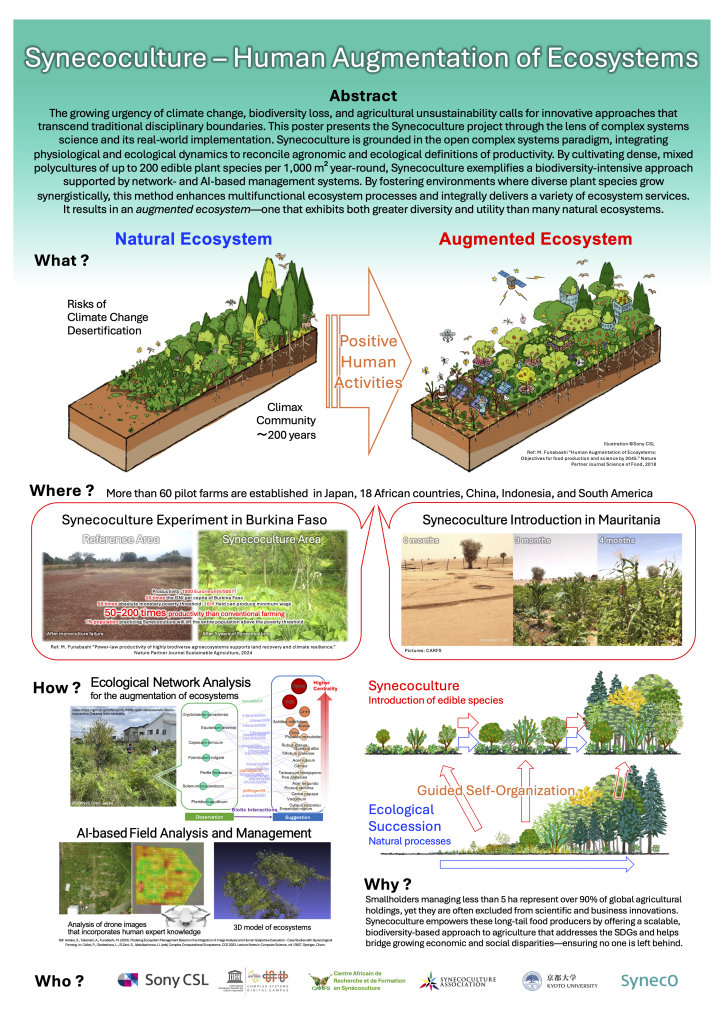
Masa Funabashi presented a poster on Synecoculture at the Conference on Complex Systems 2025, held from September 1 to 5 in Siena, Italy.
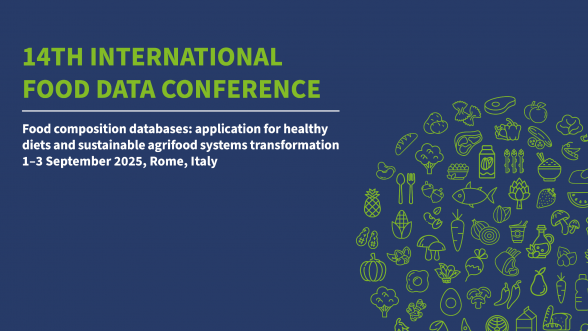
Masa Funabashi presented at the 14th International Food Data Conference, held 1–3 September 2025 in Rome, Italy.
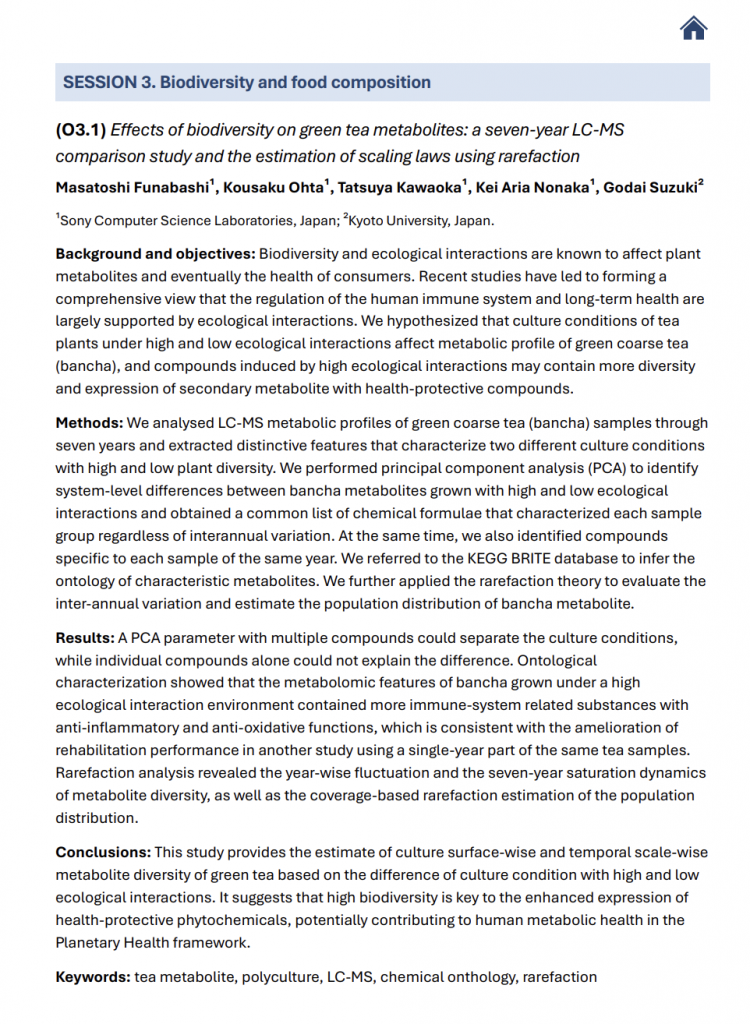
Oral presentation title: Effects of biodiversity on green tea metabolites: a seven-year LC-MS comparison study and the estimation of scaling laws using rarefaction
Authors: Masatoshi Funabashi, Kousaku Ohta, Tatsuya Kawaoka, Kei Aria Nonaka, Godai Suzuki
See the agenda and book of abstracts
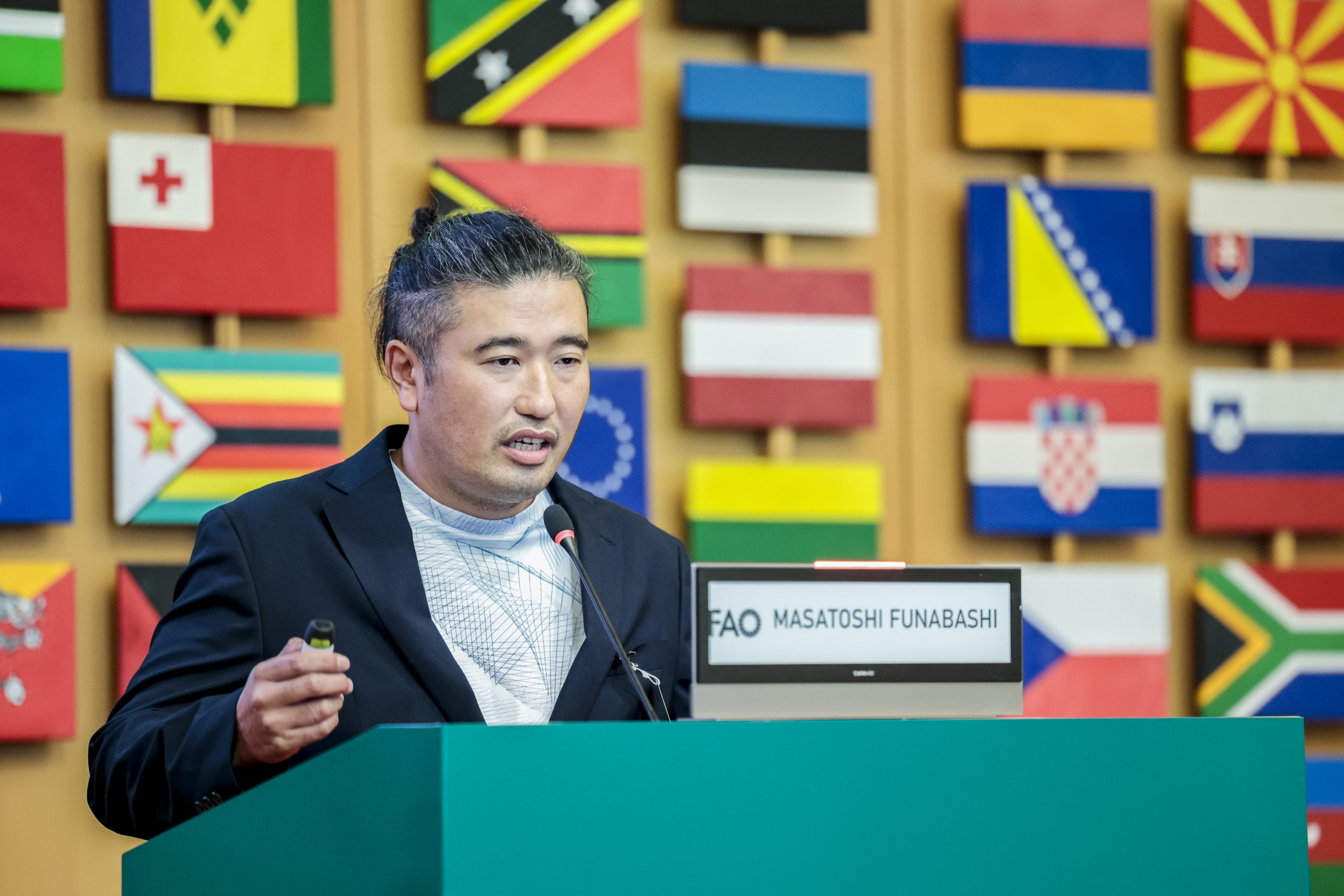
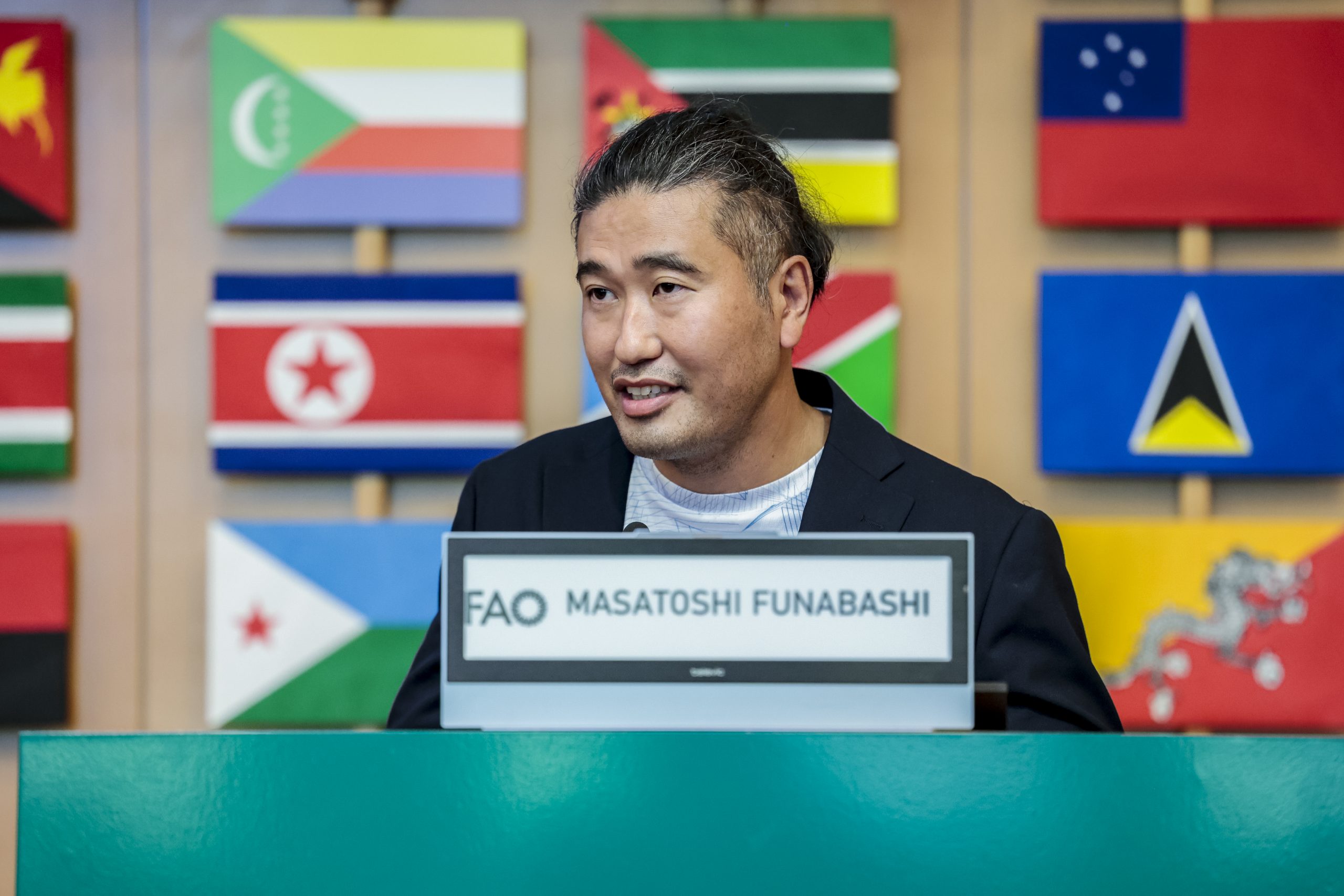
舩橋真俊が、以下のイベントに登壇しました。
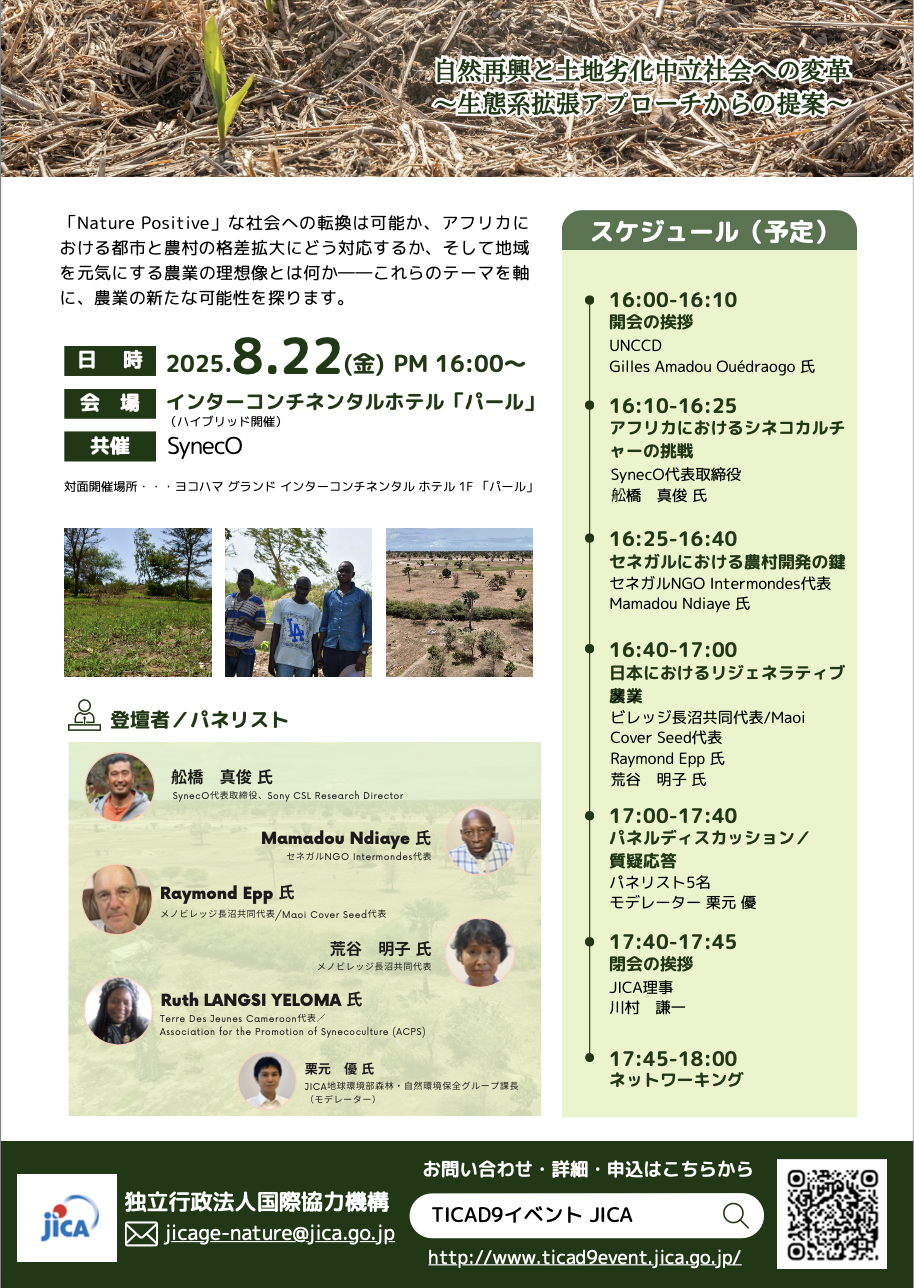
JICA主催 TICAD9サイドイベント
自然再興と土地劣化中立社会への変革~生態系拡張アプローチからの提案~
イベントWEBサイト:https://ticad9event.jica.go.jp/jp/event/detail_021.html
日時:2025年8月22 日(金)16:00~18:00
会場:ヨコハマ グランド インターコンチネンタル ホテル 1F 及びオンライン
背景
世界経済フォーラム(WEF, 2020)によれば、世界GDPの半分以上(44兆ドル相当)が自然に依存しています。しかし、全動植物種の約25%(約100万種)が絶滅の危機にあり(IPBES, 2019)、状況は依然深刻です。
2022年12月の生物多様性条約(CBD)COP15では、「昆明・モントリオール生物多様性枠組(GBF)」が採択され、2030年までに生物多様性を回復軌道に乗せ、2050年までに自然と調和した世界を実現することが目指されました。ここで「ネイチャーポジティブ(自然再興)」は、生物多様性の損失を止め、回復を図る共通目標として位置付けられました。
また、国連砂漠化対処条約(UNCCD)は「土地劣化中立(LDN)」を提唱し、土地の劣化を回復で相殺し、状態を維持または改善することを目指しています。 ネイチャーポジティブと土地劣化中立は、いずれも2030年までの環境劣化の停止と生態系回復、2050年の自然と共生する世界の実現に向けた重要な国際目標です。
中でも農業分野は、淡水使用、栄養塩の流出、化学物質による汚染、森林の土地利用転換などにより、土地劣化と生物多様性喪失に大きく影響しています。
一方で、農業における生態系サービスの活用と、人間による生態系の拡張(Ecosystem Augmentation)を組み合わせたアプローチにより、生態系への負荷を減らしつつ、自然と人の健全な機能を回復する農業の実現が可能であることが、さまざまな取り組みによって示されています。
これらは、UNCCDが推進する再生型農業やアグロエコロジーの実践とも一致しており、土壌の健康回復とLDN達成に貢献するものです。
本イベントでは、
について議論します。
キー・クエスチョン
目的
登壇者
舩橋 真俊 氏 SynecO代表取締役、Sony CSL Research Director
Mamadou Ndiaye 氏 セネガルNGO Intermondes代表
Ruth LANGSI YELOMA氏Terre des jeunes Cameroon代表/Centre Africain de Recherche et de Formation en Synécoculture (CARFS)カメルーンコーディネーター
JICA:栗元 優(モデレーター) 地球環境部森林・自然環境保全グループ課長
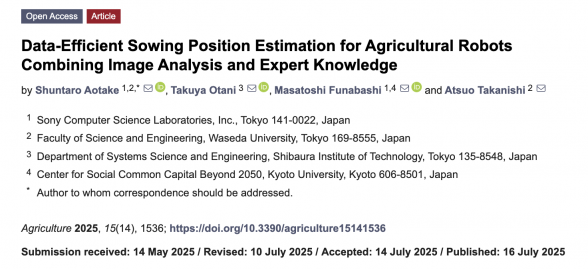
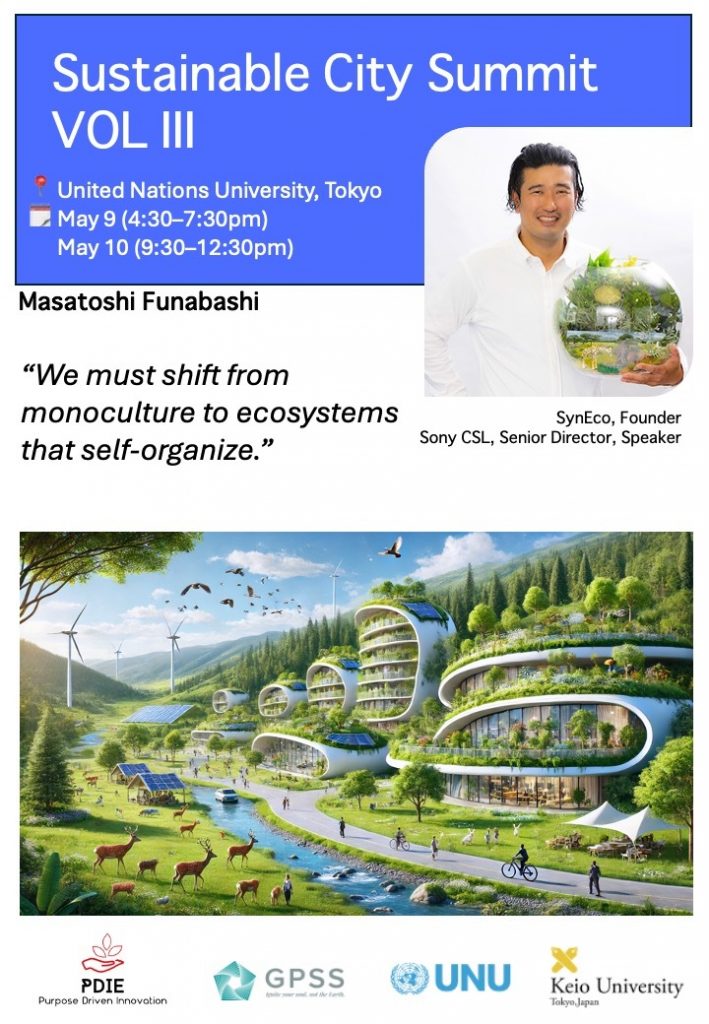
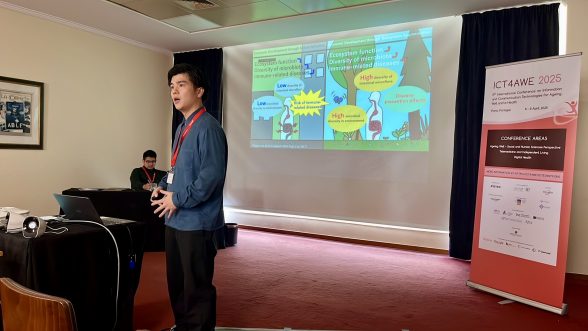
Masa Funabashi presented about Synecoculture at Sustainable City Summit VOL III held at United Nations University, Tokyo on May 10th 2025.
The world’s first Ph.D. thesis on Synecoculture is now available online:
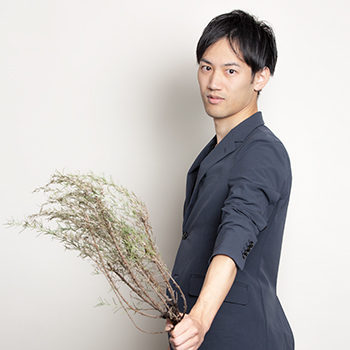
Kousaku OHTA “Research on Synecoculture: Focusing on products and soils from a system-level perspective.” doctoral thesis, Department of Global Agricultural Sciences, Graduate School of Agricultural and Life Sciences, The University of Tokyo (2023)
Abstract
Chapter.1 Introduction
As monoculture cultivation using tillage, fertilizers, and pesticides in conventional farming methods has become a major burden on the global environment, the development of new methods of food production is an urgent issue. Synecoculture, proposed in 2011, is a comprehensive approach to solving the food-environment-health trilemma, and the number of people practicing it has been increasing in recent years. Synecoculture is characterized by the production of food through the management of the entire ecosystem by mixing and densely growing many plant species with no tillage, no fertilizers, and no chemicals. While there are examples of its practice and suggested effectiveness in developing countries where fertilizer and organic resources are scarce, there is little academic verification of its effectiveness. In this study, I examined the effectiveness of the Synecoculture method mainly by comparing the quality of its products with those of conventional farming methods, and the effectiveness of this method itself from a systems- level perspective. I will also discuss the effectiveness of verification methods based on a systems-level approach. The purpose of the research is to obtain knowledge and methodology that contributes to sustainable agricultural practices through the investigation of Synecoculture as one of the counterparts to conventional farming methods in terms of complexity.
Chapter.2 Comparison of Synecoculture products and conventional farming products
A comparison of arugula (Eruca vesicaria ssp.sativa, “ルッコラ” in Japanese) and bancha (Japanese tea) grew on a Synecoculture farm and on conventional farms was conducted. In arugula, analysis of fatty acid composition suggested that arugula grown on Synecoculture farm had more antioxidant activity. In bancha, the metabolomic analysis revealed components that characterize each farming method. Vitamin B6-related compounds were detected as components that characterize Synecoculture bancha. In addition, sensory evaluation tests of Bancha were conducted, and consistency was found between the taste evaluation and the trend inferred from its characteristic ingredients. In particular, Synecoculture Bancha was superior to conventional farming Bancha in terms of abstract taste, rather than simple tastes such as umami and sweetness. These results connect agriculture’s environmental impact with the product’s health effects and suggest the importance of examining the long-term effects of growing conditions on the environment and human health from a sustainability perspective (referred to as planetary health or one-health).
Chapter.3 The effectiveness of subjective evaluation by humans
Based on the theory of Synecoculture, I implemented Synecoculture in an urban area, analyzed the diversity and activity of soil microorganisms and soil chemistry, and conducted a subjective evaluation of the ecosystem by humans. The diversity and activity of soil microorganisms were higher after two years than after one year of implementation, confirming the effectiveness of the Synecoculture farming method in improving the soil in urban areas. Comparing these data with the subjective evaluation of the ecosystem by humans, a relationship was found between the diversity and activity of microorganisms and human evaluation two years after the practice. This result suggested that trained human subjectivity can be used as an indicator for evaluating an ecosystem.
Chapter.4 Ecosystem Navigation
Augmented ecosystems, including Synecoculture, are managed to increase biodiversity and ecosystem function while observing complex ecosystems, but to do so, it is necessary to make appropriate assessments of ecosystems and learn more about their current conditions. In this chapter, I analyzed the effects of three operations (introduction of useful species, elimination of naturally occurring species, and abandonment) on two plots in an urban area using various indices. By classifying the commonalities and uniqueness of the two farms in the analysis, I was able to extract useful evaluation indicators for a complex and open ecosystem. This suggested that with the support of big data and ICT, it is possible to evaluate complex open ecosystems in detail using less expensive analytical methods.
Chapter.5 Conclusions
In this study, I have identified what kind of analysis is effective in detecting differences in complex ecosystems such as Synecoculture at various levels of hierarchy, from differences in single components of products to differences at the system level that are derived comprehensively from multiple components of products and multiple indicators such as soil data and human subjectivity. The study clarified what types of analyses are able and effective in detecting differences in complex ecosystems such as Synecoculture farms. In particular, the effectiveness of subjective evaluation by trained people showed the possibility of using human subjective evaluation with objective data background not only for Synecoculture, but also for environmentally friendly agriculture and other farming methods. Further analysis of the relationship between scientific analysis and complex human cognition is expected to enhance the effectiveness of human evaluation in assessing sustainable agriculture and the ability of people to observe nature through feedback from objective analysis. These efforts are expected to contribute to the realization of sustainable agriculture by increasing the accuracy of system-level assessment of ecosystem functions.